Thursday, October 16, 2014

False Conscious (Marxism) and The Hunger Games


An important concept that Marx introduces to explain the failure of the proletariat to recognize their position as a unified class and their need to band together in order to overthrow capitalism.  One way to think about false consciousness is the sense of hope that individual people have that they might rise to a position within the ranks of the Bourgeoisie.

This scene from the Movie "The Hunger Games" is analogous to the concept of false consciousness.  In this scene President Snow explains why The Hunger Games has a victor, rather than having all participants die, or simply rounding up the sacrifices and executing them.

President Snow: Seneca... why do you think we have a winner?
Seneca Crane: [frowns] What do you mean?
President Snow: I mean, why do we have a winner? I mean, if we just wanted to intimidate the districts, why not round up twenty-four of them at random and execute them all at once? Be a lot faster.
[Seneca just stares, confused]
President Snow: Hope.
Seneca Crane: Hope?
President Snow: Hope. It is the only thing stronger than fear. A little hope is effective. A lot of hope is dangerous. A spark is fine, as long as it's contained.
Seneca Crane: So...?
President Snow: So, CONTAIN it.

As has been noted by numerous literary and internet commentators The Hunger Games is more than a dystopian thriller, it also contains commentary and critique about our current political and economic systems.  In the fictional world of the Hunger Games an oppressive government of a fictional country named Panem has lead to vast wealth inequality: both in terms of intradistrict wealth and in comparing the capital city to the districts.   In part this wealth disparity has resulted from a failed rebellion, though it seems the disparity may also have been the initial cause of the rebellion.  In this fictional account, the capital city is filled with wealthy elites (Bourgeoisie) who own the means of production and live in a state of decadence and ease.  The proletariat are separated into 12 districts and their lives are filled with suffering and work. The separation into districts can be interpreted as an attempt to prevent further rebellion by making class identification more difficult for these workers.  The Hunger Games are an annual event where two youths (1 boy and 1 girl) are chosen from each district to compete in a battle to the death - until only one competitor remains.  In additional to providing the hope that President Snow mentions in the above clip, these games foster resentment and competition between the districts and reinforce the cultural structure within Panem that the districts deserve to be punished for their crime of rebellion.  This is particularly true as districts 1 & 2 have more resources than the other 10, allowing them to train tributes and more often win the games than other districts - this can be thought of as analogous to the Petite Bourgeoisie. 


Assignment for Week 3 (October 22)

Weber, Marx and Bourdieu all argue that various cultural structures (values, ideology, beliefs) uphold and support the social structure of capitalism. Though Marx and Weber disagree about the order of causation between capitalism and the cultural beliefs which support it, and which cultural beliefs those are.

Your assignment for next week is to identify something in United States culture that represents a cultural structure that upholds capitalism.  This can be an artifact of material culture (an object or image), a saying, or a popular individual.

For class on Wednesday:

1) Identify the example you have chosen.  You may bring in a picture, an object or simply right out a description.

2) Identify which cultural structure this example represents, and which theorist you would associate this example with.

3) Write a brief statement explaining how the example you have chosen represents the cultural structure you have chosen.

Be prepared to share you example with your peers.


Example Answer 1:

1) The popular saying attributed to Ben Franklin "A penny saved is a penny earned"

2) This saying represents the cultural structure of protestant asceticism as described by Weber.

3) Protestant asceticism was the value held by Protestants that one should live a life that is simple with few material comforts, this lent itself to Capitalism as it encouraged reinvestment of funds rather than spending funds on material possessions.  A penny saved is a penny earned encourages the saving of money rather than the spending of money on material comforts.

Wednesday, October 8, 2014

Theory: Durkheim and Functionalism

 Ă‰mile Durkheim was interested in the social causes of suicide.  Why, he wondered, were some groups more prone to suicide than others? Rather than focus upon the individual reasons for suicide (private troubles) he wanted to understand the social structures influenced the choice for suicide (public problems).  Remember, C. Wright Mills told us that private troubles are "about an individual’s character and with those limited areas of social life of which he is directly and personally aware"(Mills 1967: 395-6).  The trick of the sociological imagination is in understanding the ways that private troubles are sometimes ‘matters that transcend these local environments of the individual and the limited range of his life’ (Mills 1967: 396; Mills 1959: 8) and extend to the level of cultural and social structures.

Before we delve into the types of suicide that Durkheim's study revealed it might help to first think about the way that Durkheim understood society. Durkheim's Sociology is what we would today term Structural Functionalism.  He saw the base state of society as a peaceful state - society (and those within it) are inclined toward homeostasis (internal stability) and functionality.  Durkheim likened society to a machine (mechanical solidarity) or to a body (biological solidarity).  Both concepts point to the ways that individuals within a society interconnect, depend upon, and relate to one and other.  The clip below is from the movie Hugo - in it you will hear a very good description of a structural functional approach to society.


Functionalism - society as a great machine.

"Hugo Cabret: I'd imagine the whole world was one big machine. Machines never come with any extra parts, you know. They always come with the exact amount they need. So I figured, if the entire world was one big machine, I couldn't be an extra part. I had to be here for some reason. And that means you have to be here for some reason, too."

"Hugo Cabret: Maybe that's why a broken machine always makes me a little sad, because it isn't able to do what it was meant to do... Maybe it's the same with people. If you lose your purpose... it's like you're broken."


Hugo's observations reflect the worldview of functionalism, society is meant to function and we all have a part in that society.  If there is conflict or unrest then there is something wrong with society structurally.  Similarly, if an individual cannot find their place within society they will have negative life chances.

Durkheim's Ideas About Suicide

Your assigned reading is about Egoistic suicide, but this is only one of four kinds of suicide that Durkheim described.  Durkheim delineated four types of suicide: Egoistic, Fatalistic, Anomic, and Altruistic.  Durkheim theorized that these different types of suicide resulted from different ways that individuals related (or failed to relate) to society.  These relations can be conceived along two axis: The level of Social Integration and The level of Moral Regulation/Individuation.


Tuesday, October 7, 2014

Welcome Fall 2014 Sociology 1 Students!

Welcome to your class blog!  As I have been a TA for this course before you will find lots of resources and past assignment.

I invite you to take a look around the blog:  Check out the tags, the tabs, and past entries!

See you all on Wednesday!

~Julia

Wednesday, July 9, 2014

Bourdieu - Cultural Capital


According to Bourdieu there are 3 kinds of Capital: Economic Capital, Social Capital and Cultural Capital.

You may recall that when we discussed Marx we talked about "capital" as not just money but money that can make money. Bourdieu's ideas of capital are similar in that they are traits which can be built upon to gain more "capital."  Similarly, one kind of capital can often be exchanged or parlayed into other kinds of capital.  As you move forward you should as yourself,  "what makes a trait 'capital'?"  and "Who gets to decide which traits are valuable?"


This blog post will focus upon Cultural Capital.  Cultural capital includes symbolic elements of capital such as forms of knowledge, skills, posture, accents, mannerisms, material objects and  education.

 "Cultural capital can be acquired, to a varying extent, depending on the period, the society, and the social class, in the absence of any deliberate inculcation, and therefore quite unconsciously. It always remains marked by its earliest conditions of acquisition which, through the more or less visible marks they leave (such as the pronunciations characteristic of a class or region), help to determine its distinctive value."(Bourdieu, 1986)

 Having the "right" kinds of capital can create advantages for that person, giving them a higher status in society.  There are three categories of cultural capital:


In the scene below we see Frasier and his father struggle with having very different tastes in material objects. Though Frasier is Marty's son, he has cultivated a very different kind of cultural capital creating conflict between these two.
  1. Embodied Cultural Capital: This is capital that is related to our bodies. This can include attributes like language (accent, euphemisms, vocabulary, colloquialisms), [preferred] bodily composition (highly muscled, fake tans, body weight, manicures) and posture.  In the film stills from above we can see how actors learn to adjust their embodied cultural capital to portray characters from a variety of economic backgrounds.  A combination of acting (embodied), hair/makeup (embodied), and costuming (objectified) allows these actors to send cues that the audience can pick up on to understand the character's socioeconomic background before (or without) being told what that background is.
  2. Objectified Cultural Capital: This is material capital. These are the things we own like furniture, clothes, jewelry, and cars.  However, objectified cultural capital is more than just what we own, but what we want to own and what we decide to own.  Our tastes combined with our economic capital can combine to dictate what sorts of objects we collect. Do we prefer antique furniture or new? Do we want to spend our money on technological gadgets or a box at the opera? (see Frasier Episode Above)  
  3.   Institutional Cultural Capital:  Degrees and credentials that are acquired can be a form of cultural capital.  
We all have cultural capital and we all have a lot of cultural capital, but some kinds of capital are more valued than others. These kinds of cultural capital are seen as demonstrating cultural competence within a given field. Depending upon the field different kinds of capital are going to be valued. The cultural capital that will gain you access and acceptance at a country club is going to be quite different than the kinds of cultural capital that produce "Street Cred"

Generally,  those kinds of cultural capital associated with the upper class are more highly valued and easily parlayed into other kinds of capital.   These kinds of cultural capital can contribute social mobility, or lack there of.

Many of our readings have focused upon the way that certain kinds of cultural capital are favored within educational institutions, thus making it easier and more likely that students who already have that capital are more likely to acquire Institutional Cultural Capital.   Educational settings often favor middle-class ways of being. This is what is often called the "hidden curriculum" which pertains to attitudes and behaviors expected of students.

Tuesday, July 8, 2014

Habitus in Popular Culture


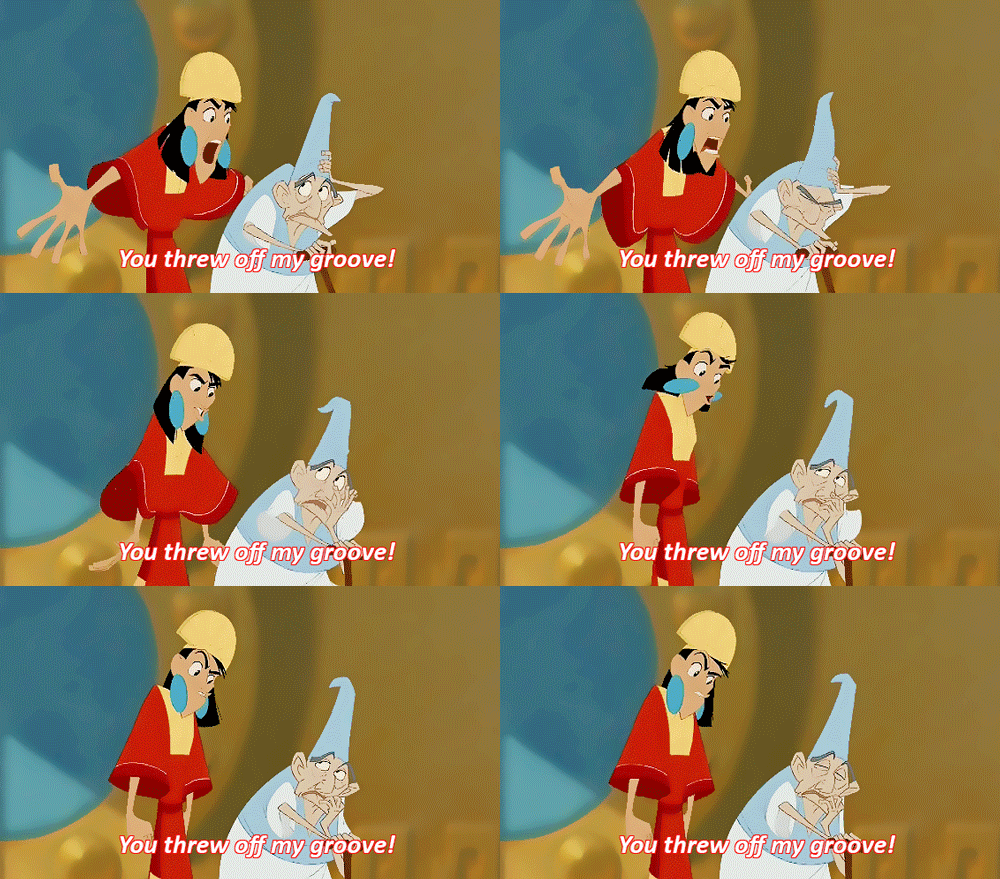
To begin with, and in short, Habitus is your way of being.  It is the collected aspects of culture that are anchored in the body or daily practices of individuals and groups. It includes the totality of learned habits, bodily skills, styles, tastes, and other non-discursive knowledges that might be said to "go without saying" for a specific group (Bourdieu 1990:66-67).  You might think of it as a persons...groove. It is also the basis for a person's cultural capital.


Old Man: "His groove! The rhythm in which he lives his life. His pattern of behavior. I threw it off. And the Emperor had me thrown out the window!" (The Emperor's New Groove).


Bourdieu tells us that our habitus, our ways of being, are at least partly instilled through the social structures around us.  Though the process of internalizing these social and cultural structures - into our tastes, habits, bodies - we are also being interpolated into an existing social hierarchy.  One that privileges certain ways of being over others, as being more legitimate and of more value.  Remember, Bourdieu is a conflict theorist, so it makes sense to see   taste (and the legitimation of certain tastes over others) as part of the class conflict.  "The main way this happens is through what he calls ‘habitus’ or socialised norms or tendencies that guide behaviour and thinking. Habitus is ‘the way society becomes deposited in persons in the form of lasting dispositions, or trained capacities and structured propensities to think, feel and act in determinant ways, which then guide them’" (Wacquant 2005: 316, cited in Navarro 2006: 16, cited on bourdieu-and-habitus).

Now our habitus is neither something we can control nor is it purely determined by structures. It is created by a kind of interplay between the two over time.  A mutually constitutive relationship between the individual and society that creates the amalgam of practices and preferences we call habitus.  In this sense habitus is created and reproduced unconsciously, ‘without any deliberate pursuit of coherence… without any conscious concentration’ (Bourdieu 1984: 170).


"embodied capital, external wealth converted into an integral part of the person, into a habitus, cannot be transmitted instantaneously (unlike money, property rights, or even titles of nobility) by gift or bequest, purchase or exchange."(Bourdieu, 1986)  But it can be changed over time.


The theme of changing an individual's cultural capital as a means to change or conceal habitus is a repeated often within popular culture.

A classic example is the movie My Fair Lady (which is a musical production of the earlier work Pygmalion).  A woman of low class standing (Eliza Doolittle) is "transformed" - coached in deportment and language by Henry Higgins - into a lady of high class standing.  In the end she is able to pass as a Duchess among the upper class at a ball.

In this first video (above) you will see Eliza early in her transformation.  If you would like to see her prior to any intervention use this link (http://www.youtube.com/watch?v=g9E8KDx2cwk).  Her Cockney accent is thick and pronounced, giving away her social standing.


 Even after Eliza is coached to speak as an upper class woman, she is still not able to pass.  Her habitus and life experiences give her away.  In the scene to the left we see Eliza socializing with the upper class at a horse race.

What is it about Eliza that gives her away?  Why does her topic of conversation reveal her class background?

This particular scene was reused in Pretty Woman a modern update of the Pygmalion story that follows the My Fair Lady plot (withe some important changes).

The narrative of transformation and "rags to riches" in these movies makes them similar to Cinderella Stories. However,Cinderella, in the original fairy tale, comes from an upper class background and has simply been oppressed by her stepmother.  She does not require a change to her habitus.  The Pygmalion narrative incorporates instilling different habits, tastes, mannerisms, gestures and language use.  In essence, the transformation of habitus.

In the end, whether it is Eliza in My Fair Lady, Vivian from Pretty Woman, Lany Boggs from She's All That the transformation is complete, but not flawless.  Contemporary versions often include a "beautiful all along" element to the plot that softens the classism inherent in these stories. For more examples go to http://tvtropes.org/pmwiki/pmwiki.php/Main/PygmalionPlot


Another example where we can see habitus in Popular Culture is the 2003 reality TV Show "Joe Millionaire."  In a gender reversal of the tropes described above in this case the individual undergoing transformation is Evan Marriott a construction worker. You can see the trailer for this show below.  Interestingly, it is Evan's habitus that gives him away.  At least one contestant, Allison, begins to suspect that Evan is not who he says he is when he fails to appreciate (or eat) the goat cheese served on one of their dates.  In her words "who doesn't like goat cheese?"


Monday, June 30, 2014

Welcome Summer Session I Students!

Welcome to your Sociology Class Blog.  This space will be yours to hold course discussions, access resources, and find assignments from class.

Feel free to browse through the previous posts, these are from earlier offerings of Sociology 1.  You may find these posts helpful.

Take some time to get to know the blog, and remember - the comments section is a great place to get talking about sociology with your class mates!

Assignment for Tuesday (July 8th):

1 - Prior to your attendance at section on July 3rd please go to the website "http://playspent.org/" and play the "spent" game at least once.

2 - Then go over to "http://www.bbc.com/news/magazine-22000973" and take the British Class Calculator Quiz.

3 - Last, go to "http://www.pbs.org/peoplelikeus/games/index.html" and take either "Identify This" or "Chintz or Shag?"